We moved to the Netherlands in 2022: I came in May, Berna in July. In 2027 we reach five years and can apply for Dutch citizenship. Whenever we talked about it, the same question came up: “If we get Dutch passports, what happens to our Turkish ones?”
The more we read the rules, the clearer it became that when you apply, who applies, and in which order completely changes the outcome. So we made a plan. In this post we walk through it step by step and note which rule applies at each step. We haven’t done it yet; we’ll update the post as we go.
Our plan at a glance
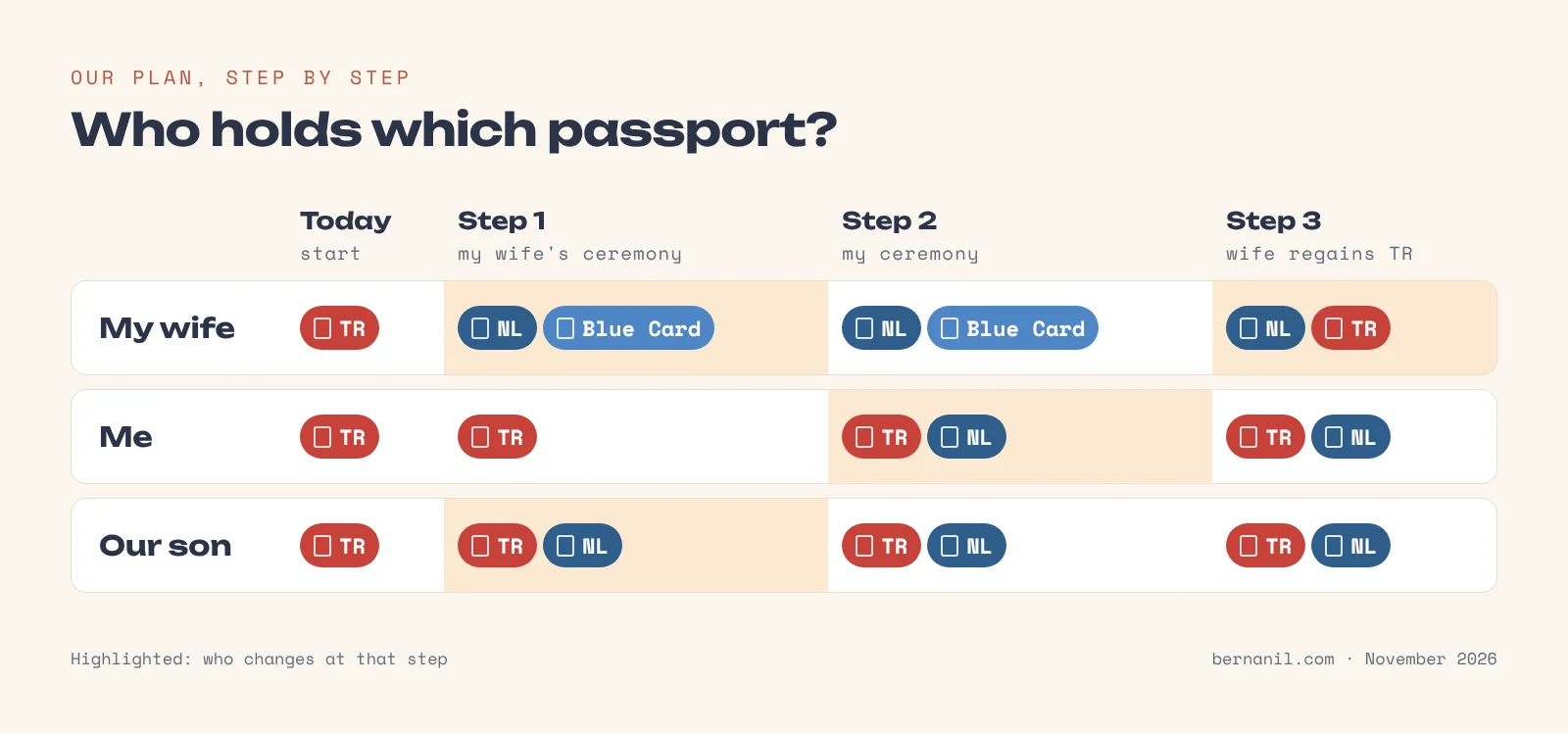
- Berna goes first. She applies for Dutch citizenship and adds our son to her application. For this she gives up her Turkish citizenship.
- Then I apply. By then I’m married to a Dutch citizen, so I don’t have to give up my Turkish citizenship.
- Berna takes back her Turkish citizenship. Because I’m a Turkish citizen, she doesn’t lose her Dutch citizenship.
- Afterwards: we keep the paperwork and renew our passports on time.
In the end all three of us have two passports, but only Berna has to go through giving up and taking back.
Why don’t we apply together?
Applying together looks like the easiest option. But then, on the day our naturalisation decision is signed, neither of us would be a Dutch citizen yet. The Netherlands asks new citizens to give up their previous nationality; one of the exceptions is being married to a Dutch citizen on that day. If we apply together, that exception doesn’t fit either of us: we would both give up Turkish citizenship and both have to go through taking it back.
Applying one after the other leaves this to one person. It has a price: a joint application is about €800 cheaper than two separate ones (details in our application post). For us, keeping Turkish citizenship matters more than that difference.
Source: IND, Renouncing your nationality
Step 1: Berna and our son go first
Once Berna becomes Dutch, she has to give up her Turkish citizenship. On the Turkish side this is called çıkma izni (permission to renounce). Roughly: after naturalisation the IND sends a reminder letter, she applies to renounce at the consulate, receives the renunciation document once the decision is made, and sends it to the IND. After that she gets the Mavi Kart (Blue Card).
With the Mavi Kart most rights in Turkey continue, such as living, working, owning property and inheriting. What goes are the right to vote and stand for election, working as a civil servant, some state benefits, and buying back pension credit for days worked abroad. Today the loss is small, but rules can change. That’s why Berna taking back her Turkish citizenship is part of the plan.
When our son is added to Berna’s application, he becomes Dutch together with her (mee-naturalisatie). This doesn’t happen automatically; he has to be included in the application. Children under 18 don’t have to give up their other nationality. And since December 2019 Turkey leaves a child’s citizenship alone when a parent renounces, unless separately requested. So our son has two passports from the start.
Sources: IND, Becoming a Dutch national through naturalisation · konsolosluk.gov.tr
Step 2: Me, without giving up Turkish citizenship
I apply after Berna’s ceremony. The key date: according to the IND, I must be married to a Dutch citizen on the day my naturalisation decision (Koninklijk Besluit) is signed. Berna’s citizenship becomes final at her ceremony, so my decision has to come after it.
I have to request this exemption when I apply; it can’t be requested after becoming Dutch. How long we have been married doesn’t matter for this exemption. Being married on the day the decision is signed is enough.
So I become Dutch without ever giving up my Turkish citizenship.
Source: IND, Renouncing your nationality
Step 3: Berna takes back her Turkish citizenship
The Dutch rule is strict: an adult Dutch citizen who voluntarily acquires another nationality automatically loses Dutch citizenship on that day. Having held that nationality before changes nothing. But there are three exceptions. A person who acquires a new nationality does not lose Dutch citizenship if they:
- acquire the nationality of the country they were born in and live there on that day,
- lived in that country for at least 5 uninterrupted years before turning 18,
- acquire the nationality of the person they are married to (or their registered partner).
They keep their Dutch citizenship.
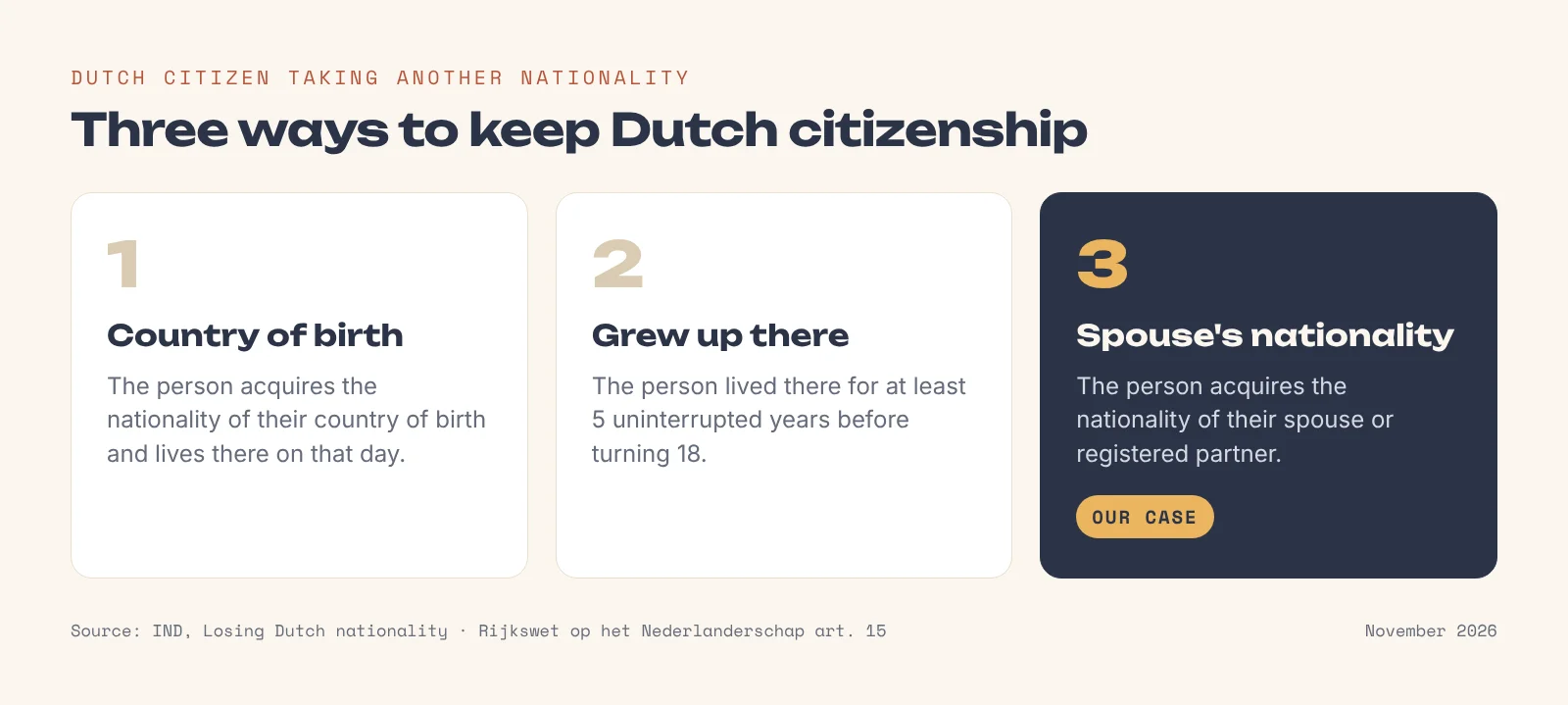
In our case the third exception applies. The person taking back Turkish citizenship is Berna. The nationality she acquires is that of the person she is married to, which is mine. Since I never gave up my Turkish citizenship in step 2, I will still be a Turkish citizen when she applies. So Berna keeps her Dutch citizenship when she takes back her Turkish one.
On the Turkish side, people who renounced with permission can apply to regain citizenship without having to live in Turkey (Law no. 5901, article 43). The application goes through the consulate and the Ministry of Interior decides. From what we’ve heard from people who went through it, it usually takes from a few months to a year; we’ll add our own timeline here once we’ve done it.
You don’t need to ask the IND beforehand. People who write to them usually get this answer: “You can check yourself whether you meet the condition; the right comes directly from the law.”
Sources: IND, Losing Dutch nationality · Rijkswet op het Nederlanderschap, article 15 · Turkish Citizenship Law no. 5901
Step 4: What we must not forget afterwards
The paperwork. The Netherlands usually asks about this at your next passport or ID application: do you have another nationality, and if so, which exception applies to you? The question comes at the first application after acquiring the other nationality. On that day Berna needs to have:
- an official document showing the date she regained Turkish citizenship,
- our marriage certificate (showing we were married before that date),
- a document showing I was a Turkish citizen on that date.
If it turns out you don’t meet the exception, your Dutch citizenship is treated as lost retroactively from the date you acquired Turkish citizenship. That’s why we’re thinking about this file already.
Renewing passports. Dual citizens who live outside the EU for 13 uninterrupted years lose Dutch citizenship. The clock restarts whenever a passport or ID card is issued, and it doesn’t run while you live in the EU. If we ever move back to Turkey, renewing our passports before they expire will be enough.
Source: Netherlands Worldwide, Losing Dutch nationality
If your situation is different
Our plan fits a married couple who are both Turkish citizens and grew up in Turkey. If you apply alone, your partner isn’t Turkish, or you were born in the Netherlands, the outcome may differ. Check the three exceptions above against your own situation; if you have any doubt, talk to an immigration lawyer.
We wrote about the application itself (how the five years are counted, the exams, A2 or B1, which partner goes first) in a separate post: Applying for Dutch citizenship.
The rules may change
A bill to make dual citizenship easier in the Netherlands (file 34632) has been waiting in parliament for years. As of November 2026 it hasn’t become law. If it does, part of this plan may no longer be needed, and we’ll update this post.
Source: Eerste Kamer, 34.632
This post describes our own plan and research; it is not legal advice. Rules can change; check the IND, Netherlands Worldwide and Turkish consulate pages before applying.