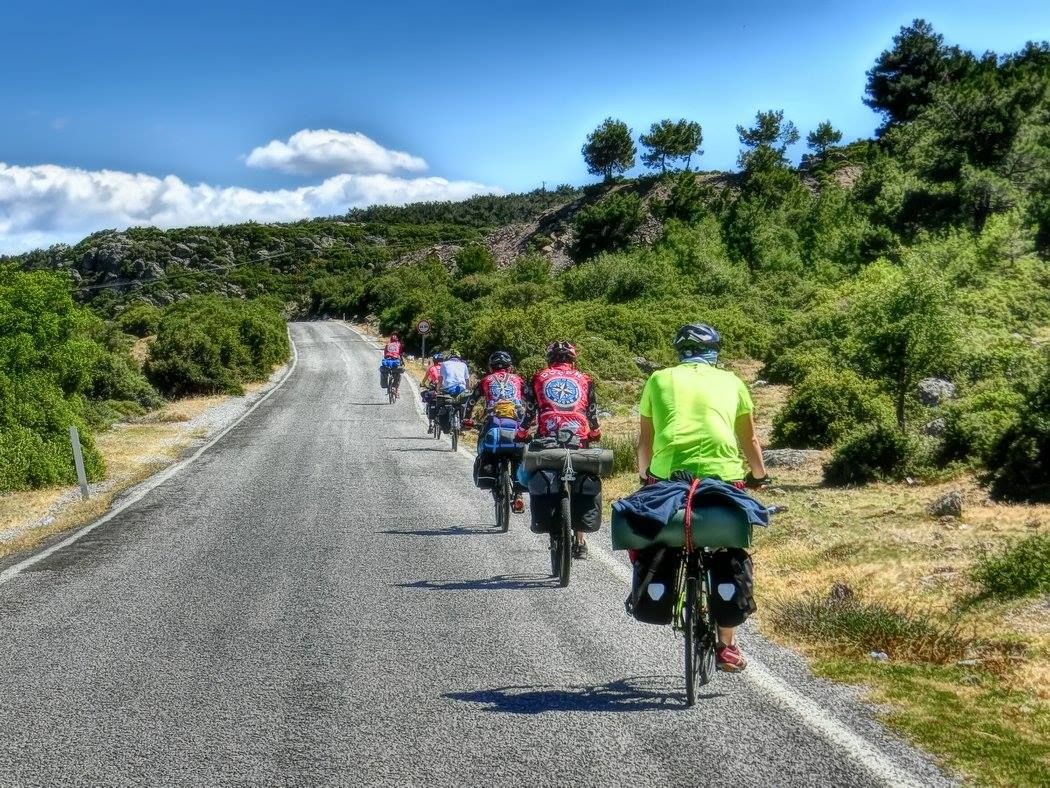
For travelling and exploring, the bike is an indispensable vehicle. Travel on two wheels, at a flow that lets you marvel at the details along the road. On the bike you're free: you can go wherever you want, stop anywhere you like, chat with the locals and really discover the place. You can pitch your tent wherever you like, cook your food on a gas stove and turn the place into your home. Of course on long tours a travel cycle like this may not be sustainable. Now and then rewarding ourselves with local flavours, or staying somewhere instead of the tent, will do our bodies a lot of good.
You'll get tired, yes! On this trip I dreamed of the tent, but if it weren't for the night I rested in a guesthouse, that day's pedalling would have been really hard on me. The most enjoyable moment on the tour is, even though you feel that ache in your knees, catching the greeting of the pleasure of success when you reach the top of the climb. The hardest part of the job is over. Now in front of you there's a sweet flat or an even sweeter descent.
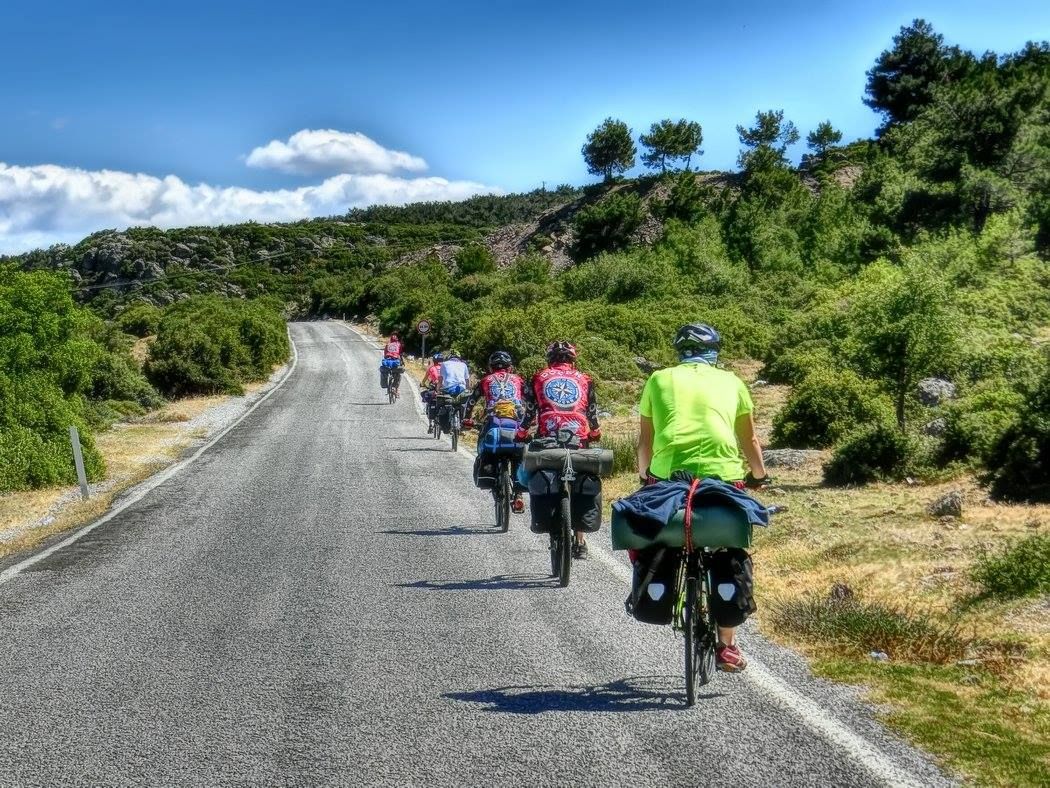
@On the way to Behramkale (Assos), 2016
In the spirit of a sweet descent, without dragging out the introduction, I return to my aim in writing this post.
We're not super cyclists who can do hundreds of kilometres on the bike every week. The only truth we knew when starting was that we could do this. I think the essence of it is to get past the "if"s and jump on the bike. In the end we realised that what we really needed was to "shut up and pedal!" Dan, Alison, Sonia and Gus.
Setting off on tour, it's not essential to hit the road on a new bike either. What matters is that the bike is sturdy and well maintained enough not to leave you stranded in the middle of the tour. I'll try to pass on the things you shouldn't skip checking before setting off.
In bike touring, preferences can of course vary from person to person. You may think you need to take a lot of things My advice to you on this will be to take as few things as possible. Things mean weight on the bike; believe me, feeling the extra your load brings in your legs on long climbs or at the end of a long distance isn't worth the load you carry. I'll soon share my detailed post on equipment here.
Choosing the Frame
On long road tours, the weight of the bike is the last thing to take into account. In that case a steel or aluminium frame can be preferred. Since bike companies now give lifetime warranties on frames, it's almost impossible to see a crack in the frame even though 50-60 kilograms of load go on the bike on the road. Here I can recommend you stay away from carbon fibre frames.
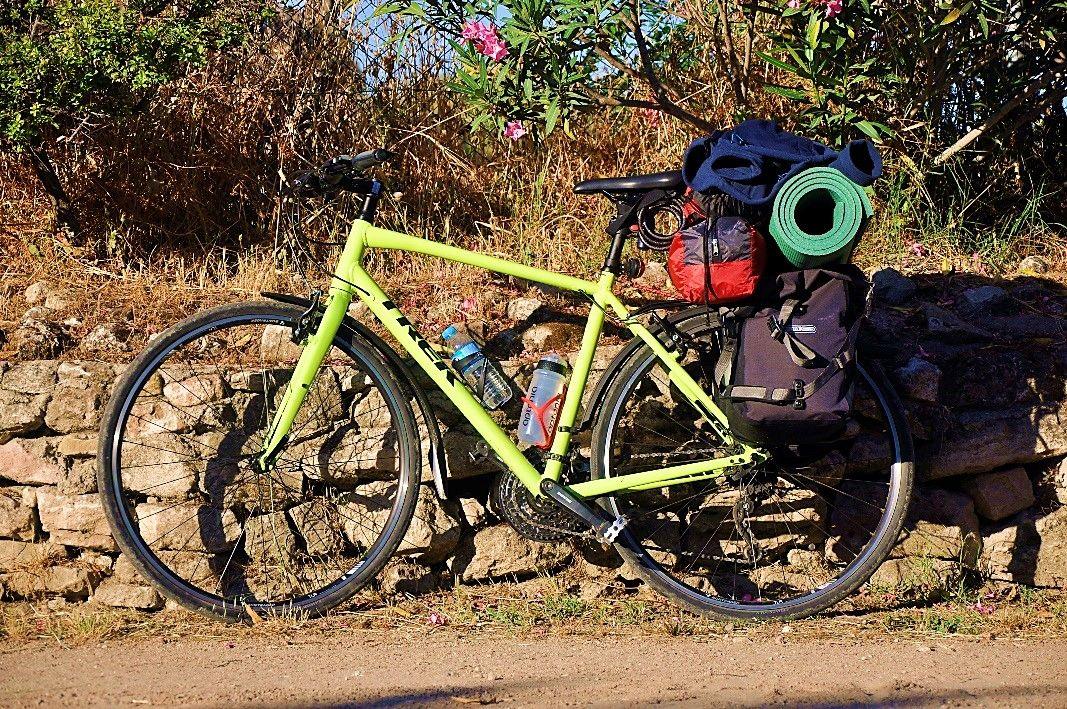
@Ancient City of Alexandria, 2016
Choosing the Suspension/Fork
On touring bikes, a rigid fork without suspension, which was also my choice, should be preferred. As I mentioned for the frame, here too you need to stay away from carbon fibre forks. But if your bike has one, or to increase your comfort when buying, a simple lockout suspension fork can be preferred.
Drivetrain
In drivetrains, the Shimano Alivio and Deore series are reasonable in price. My choice was the Alivio series on my bike. Higher-end groupsets bring lightness, but with lightness durability goes down. You need to keep this in mind. If you have no financial constraint, then unlike the open gear groups I mentioned above, among the hub gear systems, which are closed gear groups, I recommend the Rohloff hub gear system. If you have a hub gear system, rain, mud, dust and sand don't concern you at all. The German-made Rohloff gear system comes on the market with a 100,000 km warranty. To follow developing technologies in this area, you can visit the Eurobike bike fair in Germany every year in August.
Brake System
Whatever the vehicle, this subject is vitally important.
The V-brake is the most common type of brake. Two pad mechanisms at the edge of the rim squeeze, grip the rim and stop the bike. These brakes are the cheapest model and the easiest to renew and repair. In its simplest form you can do the maintenance yourself and change any part very easily. V-brakes aren't very efficient at gripping the rim, especially when wet or in rainy weather. To extend the life of the pads, you need to wipe the rims after every ride to clear them of dust and dirt.
Disc brakes are a bit more expensive than V-brakes, but for their price they also give a sturdier performance. You can stop faster while using less force than with a V-brake. Since they don't rub on the rim like a V-brake, they don't wear the rim. Rims last longer. But maintenance, repair and replacement are much harder than with a V-brake.
Tyres
The Trek FX 7.3 model uses Bontrager AW1 Hard-Case Lite 700x32c tyres. The tyre is quite light and very smooth on parts where the asphalt is good. Unlike the traditional, Tubeless tyres are used, and on dusty, dirt and glass-strewn roads I haven't yet managed to puncture a tyre. Here we can compare the tube and tubeless tyre systems like this. For the Tubeless system you definitely need to carry a spare tyre with you.
| Tube System | Tubeless System | |
| Economy | + | - |
| Lightness | - | + |
| Comfort | - | + |
| Road Grip | - | + |
|
Maintenance/Repair |
+ | - |
Handlebar
The handlebar is very important on a long tour. After riding 4-5 hours a day there can be pain in the wrists and lower back. On this I recommend you choose the butterfly handlebar, which I haven't been able to buy yet. It's very good for riding comfort, and as well as a single grip it offers quite different grip options.
The bike is a choice. While its details are this important, it can give you the most beautiful memories in your life. Now it's time for new things; if you're convinced, maybe you'll have lovely memories too.
@Mytilene Castle, 2016
May the streets you pedal always be colourful. You can find my post on the equipment and gear to use during the tour via the link.